Bahrain has announced a retrial for a hunger-striking political activist and 20 other people accused of trying to overthrow the western-backed monarchy in the Gulf state's Arab spring protests last year. Abdulhadi al-Khawaja is to be tried in a civilian court – rather than a military court as before – suggesting an attempt by the Bahraini government to respond to domestic and international criticism of its policies by finding a face-saving solution. Khawaja, 52, was sentenced to life imprisonment for plotting against the state last summer. But a three-month hunger strike and an energetic campaign by family and supporters have kept his case in the spotlight. It was raised too in the runup to the recent controversial Formula One Grand Prix in Bahrain. Khawaja is currently in a military hospital in a serious condition, having lost 25% of his body weight. The Bahrain defence forces denied in a statement on Sunday that he was being force-fed.
The decision to give him a retrial is a partial victory for Khawaja, but his family said immediately that it did not go far enough as he is to remain in custody. "Abdulhadi al-Khawaja did not go on hunger strike saying death or retrial, he said death or freedom," his daughter Maryam wrote on Twitter. "A retrial doesn't mean much." Khawaja's wife, Khadija al-Moussawi, told the BBC: "I think it is ridiculous. What sort of legal process is this? They are playing for time, and should have transferred his case to a civilian court at the first hearing, not the third." The Bahrain Human Rights Society noted that the retrial would still be based on interrogations carried out by military prosecutors.
The retrial decision is line with the so far largely ignored recommendations of the Bahrain independent commission of investigation (BICI) appointed by King Hamad Al Khalifa, which found that Khawaja had suffered prolonged torture while in detention. Khawaja has dual nationality with Denmark, and the Danish ambassador criticised the decision to keep him in custody and renewed his call for Khawaja to be transferred to Denmark on humanitarian grounds. Bahrain's government, meanwhile, has been accused of urging supporters to vote in an online opinion poll on the Radio Times website to ensure that a highly critical film about repression during last year's protests does not win the current affairs prize at this year's Bafta Television Awards. On Saturday, the Bahraini foreign minister, Khalid Al Khalifa, tweeted to his nearly 80,000 followers urging loyalists to vote against the al-Jazeera documentary Bahrain: Shouting in the Dark. The film has already won numerous awards for al-Jazeera. Human Rights Watch said in a new report at the weekend that Bahraini police were beating and torturing detainees, including minors, despite the recommendations of the BICI and public commitments to end torture and police impunity.
"Bahrain has displaced the problem of torture and police brutality from inside police stations to the point of arrest and transfer to police stations," said Nadim Houry, the deputy Middle East director at Human Rights Watch. "This abuse contradicts one of the most important recommendations of the independent commission and shows why investigations and prosecutions of abusers to the highest level are essential to stopping these practices."
http://www.guardian.co.uk/world/2012/apr/30/bahrain-retrial-hunger-striker-khawaja
See also: A call from the international network - Secularism Is A Women’s Issue (SIAWI)
To the authorities in Bahrain and to Member-States of the European Union:
http://dilipsimeon.blogspot.in/2012/04/bahrain-freedom-not-death-for-human.html
Showing posts with label Middle East. Show all posts
Showing posts with label Middle East. Show all posts
Monday, 30 April 2012

Thursday, 19 April 2012
Saudi Arabia turns deaf ear to Olympic women
This is not just about including Saudi women in the London 2012. It’s much more far-reaching and serious than that. It is an issue of silence and concurrence from the international community regarding a nation’s outright breach of international agreements and conventions.
Last Friday Sheikh Al Fowzan, ironically a member of the Saudi human rights commission, stated that the thought that the Convention on the Elimination of All Forms of Discrimination against Women (CEDAW) might be implemented in Saudi Arabia makes him shiver in fear and worry. This was during the last day of a three-day conference that took place in Qaseem, a region north of Riyadh. The conference was entitled, 'Women in the Prophet’s tradition and the modern woman: Saudi Arabia a model', and had fifteen countries participating. The assembled company came to the conclusion that Saudi Arabia should withdraw from the CEDAW agreement that it signed in 2000 - a development probably due to the religious establishment’s feeling that the government might cave in to increasing international pressure to allow Saudi women to participate in the upcoming London 2012 Olympics.
Those within Saudi who oppose the inclusion of women reason that although there is nothing in Islam that prohibits women from physical activity or even competitive sports, the future implications and consequences might be unIslamic. A paranoia has overtaken Saudi conservatives as if once a woman officially represents the country, all Saudi women at a stroke will be forced to take part and Muslim women will be parading around in swimsuits and volleyball outfits. They turn a deaf ear to anyone who argues that it clearly states in the Quran in the second chapter ayah 256 that there is no compulsion in religion. This is a nation of about nineteen million Saudis and it is unequivocally unIslamic to force only one narrow puritanical interpretation of texts on all.
Saudi Arabia still has not officially conceded to allowing women to represent them at the Olympics..
http://www.opendemocracy.net/eman-al-nafjan/saudi-arabia-turns-deaf-ear-to-olympic-women
Monday, 16 April 2012
Bahrain: FREEDOM NOT DEATH FOR HUMAN RIGHTS DEFENDER AL-KHAWAJA !
A call from the international network - Secularism Is A Women’s Issue (SIAWI)
To the authorities in Bahrain and to Member-States of the European Union
April 15, 2012
The network Secularism Is A Women’s Issue demands the immediate release of human rights defender Abdulhadi Al-Khawaja, detained and tortured, sentenced to life imprisonment in total disregard of his fundamental right to freedom of expression, on hunger strike for more than two months, and now risking death. His death in detention would be an assassination which the authorities of Bahrain would be entirely responsible for.
Abdulhadi Al-Khawaja, aged 50, has dual citizenship from Denmark and Bahrain. Today, April 15, he has been on hunger strike for 65 days, as this is the only means left to him to protest the numerous violations of his rights since his arrest, in jail, in court and even in the military hospital where he was transferred on April 3 and where he is now detained.
His human rights defender record is impeccable: Persecuted for his opinion in Bahrain, he spent twelve years in Denmark, from March 1989 to June 2001, ’with (his) wife and four brave daughters’, as he reminds the Danish Foreign Minister in an open lettere dated February 14; this is where he was trained as a human rights defender and how he acquired Danish citizenship. He
subsequently became the Director of the Bahrain Human Rights Organisation ( BHRO) based in Copenhagen. From 2002 to 2008, he was the Director of the Bahrein Center for Human Rights, and from August 2008 to February 2011, he was the MENA regional field coordinator for Frontline, the international foundation for the protection of human rights defenders based in Dublin, Ireland.
As women, we give special consideration to the fact that Abdulhadi A-Khawaja is also a women’s rights defender. Both his daughters, Zainab and Maryam, are activists in human rights organisations, both are presently persecuted by the authorities, one facing numerous arrests, the other now in exile. This testifies to the high standard of universal humanist values their father raised them in.
Back to Bahrain after a general amnesty, he is arrested on April 8, 2011. -Following a crackdown on a wide popular protest, he is ’severely beaten, arbitrarily detained, held in solitary confinement and subjected to torture for more than two months, brought before a military court on charges faked by the National Security Apparatus, and sentenced to life imprisonment’. In this above mentionned letter to the Danish Minister, he also denounces previous other violations of his rights: ’detained in 2004, severely beaten during peaceful protests in 2005 and 2006, subjected to unfair trials, travel ban and continuous defamation campaigns in official and semi official media’.
The deterioration of the detained defender is as follows:
Al-Khawaja was gravely tortured in detention. He was in very bad physical condition when he started his hunger strike, on February 8, 2012. Since then, he was surviving on one liter of salted water with glucose a day. From the 10th of March, in protest against bad treatment, he puts an end to all forms of cooperation: he refuses any check ups. On March 14, he has already lost 25% of his weight. On April 2, his lawyers request his ’release pending court decision’. The court of Cassation refuses. The court also refuses to include BICI’s report (Bahrain Independant Commission of Inquiry ) in the case records. Al-Khawaja then calls his family and lawyer and informs them of his decision to stop intake of glucose.
He is hospitalised on April 3. On April 4, he is completely unable to move, he has very low blood pressure and blood sugar. Since April 7, we know that he can hardly breathe. He told his wife about mistreatment from military hospital staff and the guards. He asks to be transferred to another
hospital and threatens to stop drinking water if there is no change. He declared: ’I will not accept this. I lived free and proud outside your prison and I live free and proud inside’. On April 12, he was informed by doctors that his condition was very critical and that he may go into a coma. Photos show a man in highly distressed physical condition. He was put on a IV that kept him conscious, but doctor said hospital IV drip ’would not be enough to keep him alive’.
However, neither his family nor his lawyer were given permission to visit him. His wife, Khadija Al-Mussawi, confirms that he was allowed to make a brief call to his family -may be his last one - to inform them of his likely going soon into a coma, in exchange that he will drink a little water.
National and international protests for his liberation were numerous: On February 23, Al-Khawaja calls on EU Member-states to stand up to their obligation to protect human rights defenders.
On February 28, a sit-in is organized in Bahrain. On March 14, Bahrain starts a Twitter campaign.
On April 8, thousands of protesters take to the streets in Bahrain to show support for the hunger stricker. His daughter Zainab is arrested and detained while trying to see her father in hospital on April 8. On April 14, a human chain is organized in front of the office of the United Nations in Beyrouth, Lebanon, and demands his release.
The UN Human Rights High Commissioner Bureau, Human Rights Watch, Frontline, Amnesty International, Human Rights First, the International Coalition of Women Human Rights Defenders which gathers together numerous human rights and women’s rights organisations, made pressing calls to the authorities in Bahrain. Civil society in Europe, Asia and Africa are now mobilizing.
Meanwhile, Denmark officially demands Al-Khawaja’s transfer to Denmark ’on humanitarian grounds’: he would receive treatment not just for the effects of his hunger strike, but also for the consequences of tortures he was subjected to in detention. Denmark Ambassador in Bahrain was not allowed to visit him on April 8 and 9. Denmark Ambassador in Saudi Arabia, Christian Köningfeldt visited him for about twenty minutes on April 10; he confirms that Al-Khawaja was still conscious. On April 10, Denmark Prime Minister, Helle Thorning Schmidt confirmed during a press conference that : 'Denmark demands that Danish-Bahraini citizen and human rights activist Khawaja be freed’. On April 9, the Head of Foreign Ministry’s consular services, Ole Engberg Mikkelsen, confirmed that no official response was given yet: 'Unfortunately, there is not much time. It is a case where the clock is ticking’, he declared.
It is now most likely that Al-Khawaja will die in the coming days unless the authorities of Bahrain accept his being transferred to Denmark.
The international network Secularism Is A Women’s Issue vigorously denounces this foreseeable murder and protests the fact that neither the UN Council of Human Rights nor EU member-states manage to obtain Al-Khawaja’s liberation at the earliest, as is their obligation under the ’Guidelines for the Protection of Human Rights Defenders’ they adopted. Al-Khawaja in his open letter to the Danish Foreign Minister stated: ’As a human rights defender, regardless of being a Danish citizen, I am entitled for protection by EU member-states in accordance with the EU Guidelines on the Protection of Human Rights Defenders around the world’.
Secularism Is A Women’s Issue insists on reminding the authorities in Bahrain that international laws, as well as universal humanist values and the religious principle of respect for human life which Bahrain adheres to, all concur and agree on this issue. Al-Khawaja must recieve treatment, keeping him in detention is a disguised death sentence.
Secularism Is A Women’s Issue calls for a mass media campaign through the mobilisation of civil society organisations in the EU member-states in order to force the states to fulfill their obligations of defending those who defend rights. Secularism Is A Women’s Issue also calls on the powerful women’s organisations and networks in Muslim countries for a wide mobilisation across continents.
Together, let’s snatch Abdulhadi Al-Khawaja’s life from the hands of its persecutors.
Before it is too late
French then English versions of the appeal in this email
http://www.siawi.org/article3519.html
http://www.siawi.org/article3518.html
Sunday, 15 April 2012
Palestinian prisoners in Israeli jails to go on hunger strike
Hundreds of Palestinian prisoners in Israeli jails are expected to embark on hunger strikes this week to draw attention to imprisonment without charge and solitary confinement. They will build on a protest that has resulted in deals to release two inmates who refused food for prolonged periods. At least 11 prisoners are already on hunger strike, three of whom have been transferred to hospital. One began refusing fluids last week, increasing concern about the rate of deterioration of his health.
A wave of hunger strikes is planned to begin on or around Prisoners' Day on Tuesday, held under the slogan: "We will live in dignity." About 1,600 prisoners have agreed to take part in the protest, according to Palestinian prisons minister Issa Qaraqi. "The situation inside Israeli prisons has become very dangerous and serious," he was quoted as saying. There are around 4,600 Palestinians held in Israeli prisons, according to the prisoners' rights group Addameer. More than 300 are held under "administrative detention", meaning they and their lawyers are not informed of accusations or evidence against them, no trial is held, and their term of imprisonment is determined by an Israeli military judge.
Of the 11 prisoners currently on hunger strike, two have refused food for 46 days. Bilal Diab, 27, who has been held under administrative detention since last August, has also refused fluids either orally or intravenously since 8 April, and has lost consciousness a number of times, according to Physicians for Human Rights. PHR has urged the Israeli authorities to grant Diab's request to be transferred to a civilian hospital and has cited World Medical Association advice that "the body is unable to survive without liquids for more than a few days, and in most cases a hunger striker will die during the first week".
Thae'r Halahi, 34, has been held in administrative detention for 22 months, plus for five separate previous periods of between three months and one year. His condition was described as stable but commensurate with a prolonged period without food. Khadar Adnan, the first prisoner to begin a hunger strike in the current wave, refused food for 66 days before agreeing to a deal that should see him released this week after four months in administrative detention. Adnan, 33, was followed by a woman prisoner, Hana Shalabi, who was released and deported to Gaza after 43 days on hunger strike. Her family home is in the village of Burqin, near Jenin, in the north West Bank.
She considered herself "not deported but freed to Gaza", where she had never been before, she told the Guardian. "It's a victory for me." But she acknowledged that she had come under pressure from the Israeli authorities to accept the deal and end her protest, amid fears that her life was in danger. Hunger strikes were, she said, "a good and effective tool, and the only way prisoners can achieve something". She is still suffering from weakness and swollen legs since ending her protest, and is under medical supervision. "Physically it was hard, but morally I was high," she said. Shalabi, 30, had previously been held for 25 months under administrative detention, but was freed in October under the prisoner exchange deal struck by Israel to secure the release of the captured soldier Gilad Shalit. She was re-arrested on 16 February...
http://www.guardian.co.uk/world/2012/apr/15/palestinian-prisoners-israel-hunger-strike
Tuesday, 3 April 2012
Libyan Militias Turn to Politics, a Volatile Mix
TRIPOLI, Libya The militia leaders who have turned post-Qaddafi Libya into a patchwork of semiautonomous fiefs are now plunging into politics, raising fears that their armed brigades could undermine elections intended to lay the foundation of a new democracy. The militia leader from Zintan who controls the airport here in the capital has exchanged his uniform for a suit and tie and now talks about running for office - with his 1,200 armed men at his back. The head of Tripoli's military council is starting a political party, and the military council in Benghazi is preparing its own slate of candidates for local office.
Regional militias and the ruling Transitional National Council have already blocked the city of Bani Walid, once a bastion of support for Col. Muammar el-Qaddafi, from choosing its local government. Other militia leaders are volunteering their armed support as the military wings of newly formed parties.
Five months after Colonel Qaddafi's death, Libyans are counting on the ritual of the ballot box to end four decades of rule by brute force. The brigades formed to fight Colonel Qaddafi, and many others that sprang up after the fact, have thwarted the consolidation of a new central authority and become a menace to security, trading deadly gunfire in the streets of the capital, detaining and torturing suspected Qaddafi loyalists, and last week even kidnapping two members of the Transitional National Council for two days. Libya's interim leaders say they hope an elected government will have the legitimacy to rein in those militias, and the country is rushing to hold votes. The two largest cities, Benghazi and Tripoli, plan to hold local elections by May, while the Transitional National Council has promised elections in June for an assembly that will govern as it writes a new constitution.
Without a national army or police force, though, many civilians worry that the militias could bully voters, suppress votes or otherwise dominate the process, leaving Libya mired in internecine violence, torn by regional tensions or - as a recent poll suggests many Libyans may now expect - vulnerable to the rise of a new strongman. Even civilian politicians alarmed by the interplay of guns and politics say they may be powerless to resist it. 'We are very clearly saying we don't want to be part of that,' said Ali Tarhuni, a former interim oil minister and deputy prime minister now starting one of the new parties. 'But down the road, what can we do?'
Mr. Tarhuni and others say they fear that Libya could repeat the experience of Lebanon, where armed militias formed during its civil war became a permanent part of the political landscape. Already some brigades around the country, including the one at the airport, led by Mokhtar al-Akhdar, have developed independent sources of revenue, primarily from providing security services. 'Protection,' Mr. Tarhuni said. Others say Libya may yet confound the expectations of chaos on the various election days. The relatively homogeneous city of Misurata recently held peaceful elections. Here in the more divided capital and across the country, Libyan officials admit that they are banking on intangibles, like Libya?s tribal traditions, the unifying spirit of the revolution and the patriotism of its young militiamen, to maintain a degree of order. Nevertheless, Mustafa Abu Shagour, deputy prime minister of the interim government, said he expected to see guns in the streets. 'I am very worried,' he said...
http://www.nytimes.com/2012/04/03/world/africa/libya-militias-turn-to-politics-a-volatile-mix.html?_r=1
Turkish Prime Minister Warns Attack On Iran Would Be 'Disastrous'
Turkish Prime Minister Recep Tayyip Erdogan warned over the weekend that an Israeli strike on Iran would have "disastrous" consequences for the Middle East, likely sparking a regional war, Turkish newspapers reported on Sunday. Turkey is a major U.S. ally in the region and Erdogan indicated that he had expressed his concerns to President Barack Obama. Erdogan was quoted by the Turkish daily Hurriyet as warning against the "disastrous" outcome of a possible Israeli strike against Iran's nuclear facilities, saying: "The entire region would be devastated if Israel strikes Iran." Erdogan also criticized the international community for keeping mum on Israel's alleged nuclear weapons, while threatening Iran over what he said was a peaceful nuclear program., "Israel has between 250 to 300 nuclear warheads. Nobody is discussing that," Erdogan said, adding: "Iran says they would not produce nuclear weapons. They are saying that they would produce a specific amount of enriched uranium rods and stop after that."
Turkey is set to host a new round of diplomatic talks between Iran and a group of world powers -- the U.S., France, Britain, China, Russia, and Germany -- beginning on April 13. On Monday, Russia's foreign minister also strongly warned against a military attack on Iran, saying that a pre-emptive strike would violate international law. Sergey Lavrov said on a visit to Armenia that an attack on Iran would destabilize the region.
Turkey is set to host a new round of diplomatic talks between Iran and a group of world powers -- the U.S., France, Britain, China, Russia, and Germany -- beginning on April 13. On Monday, Russia's foreign minister also strongly warned against a military attack on Iran, saying that a pre-emptive strike would violate international law. Sergey Lavrov said on a visit to Armenia that an attack on Iran would destabilize the region.
An end to a nearly decade-long nuclear standoff between Iran and major world powers will be possible if the United States and its European allies recognize Tehran's right to enrich uranium, a former Iranian negotiator said in an editorial.
"Talks between Iran and the five permanent members of the U.N. Security Council plus Germany (P5+1), scheduled for next month, provide the best opportunity to break the nine-year deadlock over Iran's nuclear program," Hossein Mousavian, Iran's former chief nuclear negotiator, wrote in an editorial in the Boston Globe. Mousavian, now a visiting scholar at Princeton University in New Jersey, had been seen as a moderate when in the Iranian government. Although he is not currently a policymaker, such public presentations of Iranian thinking is rare. Iran says its nuclear program is peaceful and rejects U.S. and European allegations that it is secretly amassing the capability to produce atomic weapons. Iran has rejected Security Council demands that it halt enrichment and other sensitive nuclear work, saying it has a sovereign right to atomic energy.
Monday, 26 March 2012
To Iran from Israel: I love you
Peace activists in Israel have bombarded Iranians with a single message this week: We love you. A video has been posted on YouTube showing Israelis belonging to different ages and classes, sending messages of love and peace to Iranians. In a single day, one of the videos was viewed almost 40,000 times. "For there to be a war between us, first we must be afraid of each other," say activists on the video. "For there to be a war between us, first we must hate. I'm not afraid of you, I do not hate you, we don't hate you.
"I don't even know you, we never met an Iranian... Sometimes I see here on the TV, an Iranian, he's talking about war, I'm sure he does not represent all the people of Iran. If you see somebody on the TV who's talking about bombing you, be sure he doesn't represent all of us," say others. "We love you."
The Israeli newspaper, Haaretz, reported at the weekend that hundreds of anti-war activists also rallied in Tel Aviv on Saturday in protest at a possible military strike against Iran. A Facebook campaign of "Israel loves Iran" has also been launched, attracting more than 40,000 members so far.
Iranian cartoonist, Mana Neyestani, has reacted by posting a cartoon on his Facebook page:

by Mana Neyestani: https://www.facebook.com/photo.php?fbid=10150623195303663&set=o.400704776623920&type=1&ref=nf
Wednesday, 22 February 2012
An attack on Iran would be an act of criminal stupidity
After a decade of calamitous western wars in the wider Middle East, the signs are becoming ever more ominous that we're heading for another. And, hard as it is to credit, the same discredited arguments used to justify the disasters of Iraq and Afghanistan – from weapons of mass destruction to sponsorship of terrorism and fundamentalist fanatics – are now being used to make the case for an attack on Iran.
War talk about Iran and its nuclear programme has been going on for so long it might be tempting to dismiss it as bluster. The mixed messages about Iran coming from the US and Israeli governments in recent weeks have become increasingly contradictory and bewildering. Maybe it's all a game of bluff and psychological warfare. Perhaps Iran's offer of new talks or this week's atomic energy inspectors' visit might lead to a breakthrough.
But the mood music has become more menacing. US defence secretary Leon Panetta has let it be known there is a "strong likelihood" Israel will attack Iran between April and June, even as Barack Obama says no Israeli decision has yet been taken. US officials told the Guardian last week they believed the administration would be left with "no alternative" but to attack Iran or watch Israel do so later this year.
Meanwhile, a US-Israeli stealth war is already raging on the ground, including covert assassinations of scientists, cyber warfare and attacks on military and missile installations And Britain and France have successfully dragooned the EU into ramping up sanctions on Iran's economic life-blood of oil exports as a buildup of western military forces continues in the Gulf.
Any of this could easily be regarded as an act of war against Iran – and Iranian retaliation used as the pretext for a more direct military assault, as the risk of escalation grows. But instead of challenging what is a profoundly dangerous path to full-scale regional conflict – with or without western intervention in Iran's ally, Syria – the bulk of the western media and political class is busy softening up the public to accept another war as the unfortunate consequence of Iranian intransigence...
Journalists killed in Syria
The veteran Sunday Times correspondent Marie Colvin and the French photographer Remi Ochlik have been killed in the Syrian city of Homs after an artillery shell hit the house in which they were staying. Two other foreign reporters, as well as seven activists from the ravaged Bab al-Amr neighbourhood, were also wounded on Wednesday. One of the injured is freelance photographer Paul Conroy, who was travelling with Colvin.
In the deadliest period for the media since the uprising in Syria began, at least three activists have also been killed. The three Syrians had all played prominent roles in chronicling the regime's assault on Homs over the past four months. One of those killed was the video blogger Rami al-Sayed, also known as Syria Pioneer, who had uploaded to the internet at least 200 videos of killing and destruction in his neighbourhood.
Colvin, a decorated foreign correspondent with more than 30 years of experience in conflict zones, and Ochlik, who last month won a World Press Photo award, died instantly when the shell struck the safe house that had been provided for them by local activists just after 9am. Colvin's body, along with Ochlik's, was recovered from the rubble just after 1pm.
Colvin's editor, John Witherow, released a statement that said: "Marie was an extraordinary figure in the life of the Sunday Times, driven by a passion to cover wars in the belief that what she did mattered. She believed profoundly that reporting could curtail the excesses of brutal regimes and make the international community take notice. Above all, as we saw in her powerful report last weekend, her thoughts were with the victims of violence.
"Throughout her long career she took risks to fulfil this goal, including being badly injured in Sri Lanka. Nothing seemed to deter her. But she was much more than a war reporter. She was a woman with a tremendous joie de vivre, full of humour and mischief and surrounded by a large circle of friends, all of whom feared the consequences of her bravery."
Colvin and Ochlik had been in the Bab al-Amr area of Homs for the past week reporting on the bloody siege of opposition-held parts of Syria's third city, which has claimed hundreds of lives and led to a humanitarian crisis.
The house in which the reporters were based was located next to a hospital and had been the main refuge for all reporters who had made it to Bab al-Amr in the face of a relentless barrage by regime forces over the past few weeks.
An activist for the campaigning group Avaaz who witnessed Wednesday's attack said: "I left the house after it got struck and headed to a house across the street. The shelling continues and the bodies of the journalists are still on the ground. We can't get them out because of the intensity of the shelling even though we're only a few metres away from them."
Another witness told the Guardian that rockets were continuing to rain down on the area as the wounded tried to escape the bombed house. A graphic video posted on the internet showed the two-storey house in ruins – a scale of damage that could only be caused by a heavy artillery round. Two bodies were visible in the rubble.
Three of the wounded are understood to be in a serious condition and in urgent need of treatment. They face a long and perilous drive to the Lebanese border where Red Cross officials are preparing to meet them. The French foreign minister, Alain Juppé, confirmed the death of Ochlik, who was 28. The foreign secretary, William Hague, said he was "saddened by the terrible news of the death of Ms Colvin".
The foreign editor of the Times, Richard Beeston, released a short statement on Twitter that read: "Terrible news about Marie Colvin. First worked with her Beirut 85. Most courageous, glamorous foreign corr I have ever met. Tragic loss." Colvin used a web forum to make what is believed to be her last post on Tuesday.
"I think the reports of my survival may be exaggerated," she wrote. "In Baba Amr. Sickening, cannot understand how the world can stand by and I should be hardened by now. Watched a baby die today. Shrapnel, doctors could do nothing. His little tummy just heaved and heaved until he stopped. Feeling helpless. As well as cold! Will keep trying to get out the information."
On Tuesday night, Sayed also lodged a final missive. "Baba Amr is being exterminated. Do not tell me our hearts are with you because I know that. We need campaigns everywhere across the world and inside the country. People should protest in front of embassies and everywhere. Because in hours, there will be no more Baba Amr. And I expect this message to be my last."
Iran's supreme leader says atomic weapons are 'useless, harmful and dangerous'
Iran's supreme leader has said the Islamic republic is not seeking nuclear weapons, saying they are "useless, harmful and dangerous". Ayatollah Ali Khamenei was speaking after meetings with Iranian nuclear scientists and officials on Wednesday. He did not mention a visit this week to Iran by the UN nuclear watchdog.
The International Atomic Energy Agency team left Tehran on Tuesday without finding any way forward in attempts to persuade Iran to talk about suspected secret work on atomic arms. In remarks broadcast on state TV, Khamenei said atomic weapons do not bring power but that Iran's achievements in nuclear technology, including proficiency in the nuclear fuel cycle from extracting uranium ore to producing nuclear fuel, have brought dignity and pride to the nation.
Khamenei, who has the final say on all state matters in Iran, also said that western powers know "we are not seeking nuclear weapons because the Islamic Republic of Iran considers possession of nuclear weapons a sin ... and believes that holding such weapons is useless, harmful and dangerous".
He added: "The Islamic Republic of Iran wants to prove to the world that possessing nuclear weapons does not bring power and that might doesn't come from atomic weapons. Might based on nuclear weapons can be defeated and the Iranian nation will do this."
Wednesday, 11 January 2012
Iran, Israel and the West: Goading a regime on the brink
Mostafa Ahmadi-Roshan was not the first Iranian nuclear scientist to be killed like this. In November 2010, not very far from the scene of today's assassination there were two identical attacks, in which a motorcycle drew up alongside the victim's car while it was in traffic and the riders stuck a magnetic bomb on the door. The bombs detonated as the assassins rode off.
One of those bombs killed Majid Shahriari, a member of the nuclear engineering faculty at Shahid Beheshti University in Tehran who was working on research projects with the Atomic Energy Organization of Iran(AEOI). The other slightly wounded Fereydoun Abbasi-Davani, the subject of UN sanctions and widely suspected in the West of involvement in nuclear weapon design...
Iranian officials have been quick to blame Israel, and the Israelis have not been going out of their way to avoid suspicion. On Tuesday, the head of the Israeli Defence Force, Lieutenant General Benny Gantz was quoted as telling a parliamentary panel that 2012 would be a "critical year" for Iran in which it would be subject to "unnatural" events.
The Israeli military establishment has a motive to claim successes in the covert war on Iran, because they are under political pressure to start an overt one. The generals, however, know that Israeli air strikes would unleash a war without accomplishing their goal of destroying the Iranian nuclear programme.
A covert war, based on assassinations and sabotage, may appear a better alternative. Individual killings may not seriously hinder a large, wide-ranging programme, but they would certainly deter young Iranians from taking that line of work. But such a campaign is not without huge risks for the region. The regime in Iran has clearly tried to hold its nerve, avoiding overt reprisals that might in turn provoke a military response. But elements of the establishment do seem to be lashing out in frustration...
Wednesday, 28 December 2011
Egyptian army officer's diary of military life in a revolution
Despite the crucial role played by the military in Egypt's upheaval, little is ever heard from those at the heart of the armed forces: the ordinary, mid-ranking personnel whose loyalty to the military, or lack of it, could yet determine the outcome of the revolution. Now, one insider has penned a unique account of life in the Egyptian army. A reserve officer for several years, he was in active service throughout the anti-Mubarak uprising and worked through this year's unrest before completing his duty in late 2011. The officer's name and identity has been concealed; the text below has been edited for clarity and to preserve the writer's anonymity.
"Officer training was intense. Our days started at 5am, and conditions were terrible. It was an attempt to 'break us' and transform us from civilians to military men. The hours were filled with pointless assemblies and formations where we'd stand for hours in the sun, the recital of army songs, singing the national anthem daily and following orders from the sergeants and warrant officers who would treat us terribly. But even those who gave us lessons would complain about the army and tell us how surprised and shocked they were at how different it had been from their expectations, and how frustrated they were at being unable to leave.
Regulation food was awful and served most of the time with dirty plates and spoons; it was partly bad management but I also believe they arranged things like that deliberately as it was possible to buy your own food instead from the well-stocked cafeteria and this was a way for the army to make money.
Punishment for misdemeanours included being forced to stay at the training academy on your days off, being made to lie down with your hands behind your back and then crawl on the ground, and being told to stand under the sun for an hour in full uniform and equipment, or getting thrown into military jail. It was all designed to humiliate you, but often we preferred being sent to jail; it was better than the normal daily schedule because at least it meant we were out of the sun.
Sometimes we'd rebel until the prison was full, at which point they'd have to try and be nicer to us...
Monday, 26 December 2011
America, Israel, Iran: a shifting risk
The many factors that are contributing to an increase of tension over Iran's nuclear ambitions were noted in the previous column in this series. They include anexplosion at an Iranian missile-plant, the capture of a CIA surveillance-drone, the rhetoric of Republican politicians in the United States, and a hawkish speech by the diplomatic insider and Barack Obama's former adviser on middle-east issues, Dennis Ross (see "America, Israel, Iran: war in focus", 15 December 2011).
The column noted that - Ross's informed viewsnotwithstanding - the perception of many analysts is that the Obama administration does not anticipate a military confrontation with Iran. This judgment has been reinforced by the remark of the US defence secretary Leon Panetta that a war with Iran could have dangerous consequences.
Amid these circumstances and signals, the column highlighted a longer-term strategic issue that might transcend more immediate concerns: the likelihood that Iranian influence in Iraq after the US troop withdrawals, and Washington's fear of Iranian regional power, might both increase to the point of confrontation.
The risk
The past week has seen three developments that bear on this argument. The first is the attempted arrest in Iraq on terrorism charges of the leading Iraqi Sunni politician and the country's vice-president, Tariq al-Hashemi. He has sought refuge in Kurdish Iraq, with his pursuer - Iraq's (Shi'a) prime minister, Nouri al-Maliki - requesting that the Kurds hand him over to the Baghdad authorities.
Whatever the basis of the allegations, the incident appears a case of a Shi'a-dominated government consolidating its (sectarian) power at the expense of Iraq'sSunni minority - even to the extent of abandoning the power-sharing process..
Sunday, 25 December 2011
Iraq: What Remains
The world has changed a great deal since the US invasion of Iraq in March 2003–thanks in part to that invasion and to the earlier invasion of Afghanistan. And yet, watching President Barack Obama welcome home the troops at Fort Bragg on December 14, and the media coverage of that event, it struck me that one thing has not changed. Despite the vast expenses incurred by news organizations following the occupation, and the considerable time that politicians in Washington spent debating its merits, many Americans continue to see in Iraq a reflection of their own country’s ideals and contradictions. They will remember Iraq as an American trauma. But it was, above all, an Iraqi trauma.
The country that George W. Bush and Tony Blair have left behind is free of Saddam Hussein, but it is needy and volatile and may tip back into sectarian war. In addition to 4,500 US soldiers, well over 100,000 civilians have lost their lives. Millions have fled into exile or have had to leave their homes in Iraq, ancient Christian communities have been obliterated, and only a shared pursuit of oil revenues keeps the country’s most important groups (the Shia Arabs, the Sunni Arabs, and the Kurds) precariously united. Even for a president seeking re-election, Obama’s description of Iraq as “sovereign, stable, and self-reliant” seems unduly optimistic.
The ramifications of the US-led coalition’s failure extend far beyond Iraq’s borders. Had the operation in Iraq succeeded, Iran could well have been next. Obama’s Iran policy is relatively cautious, relying on containment through sanctions and, possibly, acts of sabotage. But there can be no doubt that the power of Iran in Iraq and in the region has increased as a result of the USinvasion. It is hard to imagine America and its allies again launching such a vast military enterprise, or presenting it as part of something so obscure and unexplained as a “war on terror.” America’s failure in Iraq marks the end of a century of ill-judged invasions, coups, and other attempts by western powers to manipulate events in the Middle East. It is an important moment.
The neocons regarded intervention in Iraq as a means of establishing a beachhead for liberal, democratic values in the region...
Sunday, 18 December 2011
Egypt clashes continue into third day as army cracks down
Troops and protesters are clashing for the third straight day in Cairo, pelting each other with rocks in skirmishes near parliament in the heart of the Egyptian capital.
At least 10 protesters have been killed and 441 wounded in the three days of violence which began when one of several hundred peaceful protesters staging a sit-in outside the cabinet offices was detained and beaten by troops. The protesters are demanding that the nation's ruling military immediately step down.
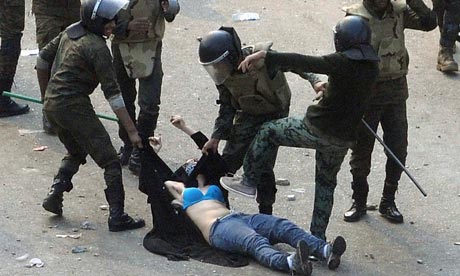
Egyptian army soldiers arrest a female protester during clashes at Tahrir Square, pulling up her head scarf and dragging her through the street. Photograph: Reuters
Sunday's clashes are taking place as unofficial results from a second round of voting in parliamentary elections show the continued dominance of Islamist parties at the polls. The third and final round of voting is slated for next month.
On Saturday, troops pulled women across the pavement by their hair, knocking off their headscarves. Young activists were kicked in the head until they lay motionless in Tahrir Square, Cairo. Unfazed by TV cameras catching every move, Egypt's military took a dramatically heavier hand to crush protests against its rule. The most sustained crackdown yet is possibly a sign that the generals who took power after Hosni Mubarak was ousted in February are confident that the Egyptian public is on its side after two rounds of parliamentary elections, and that Islamist parties winning the vote will stay out of the fight while pro-democracy protesters become more isolated.
Still, the generals risk turning more Egyptians against them, especially from outrage over the abuse of women. Photos and video posted online showed troops pulling up the shirt of one woman protester in a conservative headscarf, leaving her half-naked as they dragged her in the street.
Subscribe to:
Posts (Atom)