Japan's $5 trillion economy has relied heavily on nuclear power for decades, with its reactors providing almost 30 percent of electricity needs, but last year's massive earthquake and subsequent nuclear crisis spurred a public backlash against atomic energy. Cabinet ministers have largely failed to win over the public to allow the restart of the country's plants - shut one by one for scheduled maintenance and unable to resume operations because of concerns about safety.
Japan's Asahi newspaper said public sentiment was "wavering between two sources of anxiety" - fear over the safety of nuclear power and doubts on whether Japan can live without it. "The public shouldn't just criticise (the government) but make its own decision on energy policy that involves burden and responsibility, such as through cooperating in power saving," the paper said in an editorial on Sunday. The government hopes to come up with an estimate by mid-May of expected shortages this summer, and will then produce a plan to conserve energy that could include compulsory curbs on use of power, Japanese media say. But setting a long-term energy policy or a clear timeframe for restarting the plants will take time given strong public opposition and a divided parliament that has paralysed policy-making, analysts say...
http://in.reuters.com/article/2012/05/06/nuclear-japan-idINDEE84503H20120506
See also: Table showing status of 50 reactors with capacity of 46,148 megawatts:
http://www.bloomberg.com/news/2012-05-07/japan-nuclear-power-free-after-shutdown-of-last-reactor-table-.html
Showing posts with label ecology. Show all posts
Showing posts with label ecology. Show all posts
Sunday, 6 May 2012

Monday, 30 April 2012
The State of India's Forest Rights Act
The Asian Indigenous and Tribal Peoples Network (AITPN) shares its latest report The State of the Forest Rights Act. This is a comprehensive study on the flawed implementation of the Scheduled Tribes and Other Traditional Forest Dwellers (Recognition of Forest Rights) Act, 2006.
It is available at http://www.aitpn.org/Reports/Forest_Rights_Act_2012.pdf
As of 31 January 2012, a total of 31,68,478 claims have been received and 27,24,162 claims (85.98%) have been disposed off. Out of the total claims disposed off, 12,51,490 titles (45.94%) were distributed and 14,72,672 claims (54%) were rejected. In terms of rejection rate, Uttarakhand is on the top with 100% followed by Himachal Pradesh (99.62%), Bihar (98.12%), Karnataka (95.66%), Uttar Pradesh (80.48%), West Bengal (73.12%), Maharashtra (67.91%), Madhya Pradesh (63.32%), Chhattisgarh (55.86%), Jharkhand (53.13%), Assam (50.94%), Rajasthan (49.85%), Andhra Pradesh (47.76%), Gujarat (30.95%), Orissa (30.75%), Kerala (16.95%), and Tripura (15.07%). The rejection rate of as many as 11 states is above 50 per cent.
The claims are being rejected on frivolous grounds. The Forest Rights Committees have not been constituted at the Gram Sabha level in several states as provided in the Act while the forest officials have been obstructing the process of verification and decision making at various level. The claimants are denied proper hearing of their cases and opportunity to file appeal against the rejections. In an overwhelming number of cases, the rejections are not being communicated to the claimants.
The Community Forest Rights (CFRs) are not being recognized and in many States even the forms are not supplied. The claims under the FRA are not being recognised in the protected areas such as National Parks and Wildlife sanctuaries. The Other Traditional Forest Dwellers are being denied rights under the FRA. Even in cases where land titles are issued, they are vaguely worded and
often without clear maps or demarcation of any boundary, area etc. In many cases, more than one person/family has been granted title over the same plot of land.
The Scheduled Tribes and Other Traditional Forest Dwellers (Recognition of Forest Rights) Rules, 2007 actually overrules the Act to deny rights to the beneficiaries. In clear violation of the FRA, under Rule 14(3) of the Forest Rights Rule 2007 the Sub-Divisional Level Committee has been
empowered to reject the claims without any explanation.
The Ministry of Environment & Forests and the Ministry of Tribal Affairs which have jointly constituted the National Committee on the FRA have undermined the National Committee. On 3 August 2010, Kanti Lal Bhuria, then Union Minister of Tribal Affairs, raised objections to the
functioning of the National Committee on the FRA. Further, in October 2010, Jairam Ramesh, then Union Minister of Environment and Forests in a letter to the Chairperson of the National Committee expressed unhappiness over the suspension of a Divisional Forest Officer by the Uttar Pradesh
government after an investigation by senior officials vindicated the findings of irregularities as pointed out in the report of the National Committee on FRA.
The Action Taken Report on the Tenth Report, “Implementation of Scheduled Tribes and Other Traditional Forest Dwellers (Recognition of Forest Rights) Act, 2006 - Rules Made Thereunder” of the Parliamentary Standing Committee on Social Justice and Empowerment has been placed before the Parliament on 22.12.2011. Though the Ministry of Tribal Affairs claimed that out of the 23 recommendations, 12 have been accepted by the Government, in reality the recommendations were only forwarded to the State Governments. AITPN recommended, among others, that the National Commission for Scheduled Tribes be provided with adequate financial and human resources to examine the complaints pertaining to the claims under the Forest Rights Act.
AITPN has Special Consultative Status with the UN ECOSOC
C-3-441 (Top Floor), Janakpuri, New Delhi-110058, India
Phone: + 91-11-25503624, 45511307; Fax: + 91-11-25503624
Website: www.aitpn.org; Email: aitpn@aitpn.org
http://www.aitpn.org/Reports/Forest_Rights_Act_2012.pdf
Sunday, 22 April 2012
'They're killing us': world's most endangered tribe cries for help
Logging companies keen to exploit Brazil's rainforest have been accused by human rights organisations of using gunmen to wipe out the Awá, a tribe of just 355.
Trundling along the dirt roads of the Amazon, the giant logging lorry dwarfed the vehicle of the investigators following it. The trunks of nine huge trees were piled high on the back – incontrovertible proof of the continuing destruction of the world's greatest rainforest and its most endangered tribe, the Awá. Yet as they travelled through the jungle early this year, the small team from Funai – Brazil's National Indian Foundation – did not dare try to stop the loggers; the vehicle was too large and the loggers were almost certainly armed. All they could do was video the lorry and add the film to the growing mountain of evidence showing how the Awá – with only 355 surviving members, more than 100 of whom have had no contact with the outside world – are teetering on the edge of extinction.
Also see: Campaign to save 'world's most threatened tribe':
http://www.guardian.co.uk/environment/2012/apr/25/colin-firth-campaign-awa
Trundling along the dirt roads of the Amazon, the giant logging lorry dwarfed the vehicle of the investigators following it. The trunks of nine huge trees were piled high on the back – incontrovertible proof of the continuing destruction of the world's greatest rainforest and its most endangered tribe, the Awá. Yet as they travelled through the jungle early this year, the small team from Funai – Brazil's National Indian Foundation – did not dare try to stop the loggers; the vehicle was too large and the loggers were almost certainly armed. All they could do was video the lorry and add the film to the growing mountain of evidence showing how the Awá – with only 355 surviving members, more than 100 of whom have had no contact with the outside world – are teetering on the edge of extinction.
It is a scene played out throughout the Amazon as the authorities struggle to tackle the powerful illegal logging industry. But it is not just the loss of the trees that has created a situation so serious that it led a Brazilian judge, José Carlos do Vale Madeira, to describe it as "a real genocide". People are pouring on to the Awá's land, building illegal settlements, running cattle ranches. Hired gunmen – known as pistoleros– are reported to be hunting Awá who have stood in the way of land-grabbers. Members of the tribe describe seeing their families wiped out. Human rights campaigners say the tribe has reached a tipping point and only immediate action by the Brazilian government to prevent logging can save the tribe...
...the Awá also face a more direct threat. Earlier this year an investigation into reports that an Awá child had been killed by loggers found that their tractors had destroyed the Awá camp. "It is not just the destruction of the land; it is the violence," said Watson. "I have talked to Awá people who have survived massacres. I have interviewed Awá who have seen their families shot in front of them. There are immensely powerful people against them. The land-grabbers usepistoleros to clear the land. If this is not stopped now, these people could be wiped out. This is extinction taking place before our eyes."
http://www.guardian.co.uk/world/2012/apr/22/brazil-rainforest-awa-endangered-tribeAlso see: Campaign to save 'world's most threatened tribe':
http://www.guardian.co.uk/environment/2012/apr/25/colin-firth-campaign-awa
Tuesday, 10 April 2012
NUCLEAR RADIATION CRISIS: Fukushima to Burn Highly-Radioactive Debris
Fukushima will start burning radioactive debris containing up to 100,000 becquerels of radioactive cesium per kilogram. The state will start building storage facilities for debris generated by the March 2011 tsunami as early as May at two locations in a coastal area of Naraha town, Fukushima Prefecture, Environment Ministry and town officials said Saturday. About 25,000 tons of debris are expected to be brought into the facilities beginning in the summer, according to the officials. If more than 100,000 becquerels of radioactive cesium are found per kilogram of debris, the debris will be transferred to a medium-term storage facility to be built by the state. But if burnable debris contains 100,000 becquerels of radioactive cesium or less, it may be disposed of at a temporary incinerator to be built within the prefecture, according to the officials.
Within the 20-km-radius no-go zone spanning across Naraha and five other municipalities along the coast, debris caused by the magnitude 9.0 quake and the subsequent tsunami has amounted to an estimated 474,000 tons, much of remaining where it is. How much radiation is that?.. The radioactive debris will be burned for years … through at least March 2014. Burning radioactive debris does not destroy the radioactivity. It merely spreads it. Gundersen says that radioactivity from the burnt debris will end up not only in neighboring prefectures, but in Hawaii, British Columbia, Oregon, Washington and California. Gundersen said that burning radioactive debris is re-creating the Fukushima disaster all over again, as it is releasing a huge amount of radioactivity which had settled on the ground back into the air.
Steven Starr – Senior Scientist, Physicians for Social Responsibility, and Director of the Clinical Laboratory Science Program at the University of Missouri-Columbia, who has advised numerous countries on issues of nuclear non-proliferation – writes: Burning radioactive debris will only serve to further randomly spread radiation across Japan, as well as the rest of the world. Not only will this lead to more morbidity and mortality within Japan, but it will further complicate epidemiological studies of the Fukushima disaster. Raising “acceptable” levels of radioactive fallout is a false solution to a serious problem. It is possible for the government authorities to do this because radiation is invisible to us, and at lower doses, the consequences of exposure do not manifest themselves for some time . . . thus it is a poison that is easy to hide and ignore. Sadly, the children of Japan will be those most seriously affected by this man-made environmental catastrophe.
It is bad enough that radiation from Fukushima is spreading across the Pacific to the United States through air and water, that the Japanese are underplaying the enormous threat posed by the spent fuel pools, and that the Japanese have engaged in a massive cover-up of the severity of the Fukushima crisis. But intentionally burning radioactive debris to try to cover up the problem – and spreading radiation worldwide in the process – is an entirely separate affront. In addition to burning radioactive debris, Japan intends to build tents over the leaking Fukushima reactors. While this sounds like a way to contain the radiation, it would actually funnel it straight up and spread it globally.. http://www.globalresearch.ca/index.php?context=va&aid=30219
Indian Man Single-Handedly Plants a 1,360 Acre Forest
A little over 30 years ago, a teenager named Jadav "Molai" Payeng began burying seeds along a barren sandbar near his birthplace in northern India's Assam region to grow a refuge for wildlife. Not long after, he decided to dedicate his life to this endeavor, so he moved to the site where he could work full-time creating a lush new forest ecosystem. Incredibly, the spot today hosts a sprawling 1,360 acre of jungle that Payeng planted single-handedly. While it's taken years for Payeng's remarkable dedication to planting to receive some well-deserved recognition internationally, it didn't take long for wildlife in the region to benefit from the manufactured forest.
Demonstrating a keen understanding of ecological balance, Payeng even transplanted ants to his burgeoning ecosystem to bolster its natural harmony. Soon the shadeless sandbar was transformed into a self-functioning environment where a menagerie of creatures could dwell. The forest, called the Molai woods, now serves as a safe haven for numerous birds, deers, rhinos, tigers, and elephants -- species increasingly at risk from habitat loss elsewhere.
Despite the conspicuousness of Payeng's project, Forestry officials in the region first learned of this new forest in 2008 -- and since then they've come to recognize his efforts as truly remarkable, but perhaps not enough. "We're amazed at Payeng," says Assistant Conservator of Forests, Gunin Saikia. "He has been at it for 30 years. Had he been in any other country, he would have been made a hero."
http://www.treehugger.com/natural-sciences/man-single-handedly-plants-entire-forest.html
Friday, 9 March 2012
Banks in front line of nuclear arms campaign
Is there any further proof needed of the endemic link between capitalism, militarism and destruction? It just makes good business sense to invest in the potential for world annihilation. This precisely is why capitalist modernity must be recognised as the structural embodiment of nihilism...DS
UNITED NATIONS - The world's nuclear weapons industry is being funded - and kept alive - by more than 300 banks, pension funds, insurance companies and asset managers in 30 countries, according to a new study. And these institutions have substantial investments in nuclear arms producers. Released by the International Campaign to Abolish Nuclear Weapons (ICAN), the 180-page study says that nuclear-armed nations spend over US$100 billion each year assembling new warheads, modernizing old ones, and building ballistic missiles, bombers and submarines to launch them.
Much of this work, the report points out, is carried out by corporations such as BAE Systems and Babcock International in the UK, Lockheed Martin and Northrop Grumman in the United States, Thales and Safran in France, and Larsen & Toubro in India. "Financial institutions invest in these companies by providing loans and purchasing shares and bonds," says the report, described as the first of its kind.
Titled Don't Bank on the Bomb: The Global Financing of Nuclear Weapons Producers, the study provides details of financial transactions with 20 companies heavily involved in the manufacture, maintenance and modernization of US, British, French and Indian nuclear forces. A coordinated global campaign for nuclear weapons divestment is urgently needed, it says. Such a movement could help put a halt to modernization programs, strengthen the international norm against nuclear weapons, and build momentum towards negotiations on a universal nuclear weapons ban, it adds. "Divestment from nuclear weapons companies is an effective way for the corporate world to advance the goal of nuclear abolition."
The study appeals to financial institutions to stop investing in the nuclear arms industry. "Any use of nuclear weapons would violate international law and have catastrophic humanitarian consequences. By investing in nuclear weapons producers, financial institutions are in effect facilitating the build-up of nuclear forces," it says.
In a foreword to the report, Nobel Peace Prize winner Desmond Tutu writes, "No one should be profiting from this terrible industry of death, which threatens us all." The South African peace activist has urged financial institutions to do the right thing and assist, rather than impede, efforts to eliminate the threat of radioactive incineration, pointing out that divestment was a vital part of the successful campaign to end apartheid in South Africa. The same tactic can - and must - be employed to challenge man's most evil creation: the nuclear bomb, he said.
Tim Wright, ICAN campaign director and co-author of the report, told IPS some of the financial institutions identified in the study "have already indicated to us they intend to adopt policies proscribing investments in nuclear arms makers". Asked how confident he was of the success of the divestment campaign, Wright said, "Our divestment campaign will probably be most successful in places where opposition to nuclear weapons is strongest, for example, Japan and Scandinavia."
He said more and more banks are coming to accept that some kind of ethical criteria should be applied to investment decisions, and manufacturing weapons capable of destroying entire cities in an instant is clearly unethical. Of the 322 financial institutions identified in the report, about half are based in the United States and a third in Europe. The study also singles out Asian, Australian and Middle Eastern institutions. However, the institutions most heavily involved in financing nuclear arms makers include Bank of America, BlackRock and JPMorgan Chase in the United States; BNP Paribas in France; Allianz and Deutsche Bank in Germany; Mistubishi UJF Financial in Japan; BBVA and Banco Santander in Spain; Credit Suisse and UBS in Switzerland; and Barclays, HSBC, Lloyds and Royal Bank of Scotland in Britain. The report emphasizes the humanitarian, legal & environmental arguments for divestment, noting the unique destructive potential of nuclear weapons.. read on:
http://www.atimes.com/atimes/Global_Economy/NC09Dj02.html
Also see:The International Campaign to Abolish Nuclear Weapons (ICAN), a global grassroots organisation, has thrown a virtual bombshell: In a trailblazing report, it reveals the funders and manufacturers of 20,000 nuclear weapons in the possession of nine nuke-armed nations, which have a collective destructive force equivalent to 150,000 Hiroshima-sized bombs. Yet, undeterred by the annihilation their existing arsenal can cause, each year, the nine – the U.S., Russia, China, the UK, France, Pakistan, India, Israel and North Korea – are spending a combined total of more than US$100 billion on weapons of mass destruction by assembling new warheads, modernizing old ones, and building ballistic missiles, bombers and submarines to launch them. Don’t Bank on the Bomb: The Global Financing of Nuclear Weapons Producers is the first major global report on the financing of companies that manufacture, modernize and maintain nuclear weapons and their delivery vehicles. It identifies more than 300 banks, insurance companies, pension funds and asset managers from 30 countries that invest significantly in 20 major nuclear weapons producers.
http://www.eurasiareview.com/08032012-ican-discloses-funders-and-makers-of-20000-nuclear-weapons/
And: The Campaign for Nuclear Disarmament is pleased to support today’s launch of a groundbreaking report by ICAN - the International Campaign to Abolish Nuclear Weapons - on the global financing of the nuclear weapons industry.The comprehensive study, entitled Don’t Bank on the Bomb, identifies more than 300 banks, pension funds, insurance companies and asset managers in 30 countries with substantial investments in nuclear arms producers...The UK is home to 41 of the 322 financial institutions found to be supporting major nuclear weapons companies – the second largest amount out of the 30 countries covered by the report. Of these, the most heavily involved in financing nuclear arms include Barclays, HSBC & the part-publicly owned banks Lloyds & Royal Bank of Scotland. 5 of the twenty major nuclear weapons companies listed in the report – Babcock International, BAE Systems, Redhall Group, Rolls Royce & Serco Group – are UK-based.
Download the Report here:
http://www.dontbankonthebomb.com/wp-content/uploads/2012/02/DivestmentReport.pdf
'what is granted under fear can be retained only as long as the fear lasts'
M.K Gandhi. Hind Swaraj, or Indian Home Rule (1909)
See also:
Closing the Circle: article on Revolution in Frontier
The military spending map of the world
Annihilation as world religion
Paul Fussell, ex-soldier, literary Scholar & critic
Book review: War Is Still a Racket
Book review - An Enduring Condition: On War Time
Eternal war (Chapter n+1) - Panetta’s Pacific Vision
Shadow War: The Untold Story of Jihad in Kashmir by Arif Jamal
The End of the new world order
Wednesday, 7 March 2012
Indian Embassy denies Fukushima survivor a visa
A Japanese anti-nuclear activist has been denied visa by Indian authorities after a "mismatch" was detected in her travel document and purpose of visit. Maya Kobayashi, a survivor of Fukushima nuclear tragedy in Japan last year, was due to visit India on the invitation of Greenpeace Foundation to share her experience with the communities living close to the proposed nuclear power plants.
The Indian embassy in Japan had granted a business visa to Ms Maya on February 15 with the information that she has been invited here to attend events and people here, a Greenpeace India release said. When asked about the reasons for denial of visa to Ms Maya, official sources here said there was a "mismatch" between the visa type and the stated purpose of visit. "It is normal not to grant visas if there is a mismatch between the purpose of the visit and the kind of entry travel document one tries to obtain," a source said.
Ms Maya, a resident of Fukushima in Japan, is one of the five survivors of the nuclear tragedy who visited around a dozen countries to share their experience, but "India is the only country to revoke the visa," Greenpeace's nuclear campaigner Karuna Raina said in a release. The fact that government is going to the extent of cancelling legitimately granted visas clearly shows that they don't want people from Japan to come to India and share their experience, she added. Meanwhile Ms Maya in a statement said, "I was looking forward to coming to India and sharing my experience with people who are fighting against the dangers of nuclear energy.". Read more at
http://www.ndtv.com/article/india/indian-embassy-denies-fukushima-survivor-a-visa-183815?pfrom=home-otherstories&cp
Japan encourages a wider evacuation from reactor area
Japan encourages a wider evacuation from reactor area
Japanese officials began encouraging people to evacuate a larger swath of territory around the Fukushima Daiichi nuclear plant on Friday as new signs emerged that parts of the crippled facility are so damaged and contaminated that it will be hard to bring the plant under control soon. The authorities said that they would now assist people who want to leave the area from 12 to 19 miles outside the plant and that they were now encouraging "voluntary evacuation" from the area. Those people had been advised March 15 to remain indoors, while those within a 12-mile radius of the plant had been ordered to evacuate. The United States has recommended that its citizens stay at least 50 miles away.
Speaking to a national audience at a news conference Friday night two weeks after the magnitude 9.0 earthquake and the devastating tsunami that followed it, Prime Minister Naoto Kan dodged a reporter's question about whether the government was ordering a full evacuation, saying officials were simply following the recommendation of the Japan Nuclear Safety Commission. "The situation still requires caution," Mr. Kan, grave and tired-looking, told the nation. "Our measures are aimed at preventing the circumstances from getting worse." "The state of the plant is still quite precarious," he said. "We're working hard to make sure it doesn't get worse. We have to ensure there's no further deterioration."
In the latest setback in the effort to contain the nuclear crisis evidence emerged that the reactor vessel of the No. 3 unit may have been damaged, an official said Friday. The development, described at a news conference by Hidehiko Nishiyama, deputy director-general of the Japan Nuclear and Industrial Safety Agency, raises the possibility that radiation from the mixed oxides or mox fuel in the reactor -- a combination of uranium and plutonium -- could be released. Read more at: http://www.ndtv.com/article/world/japan-encourages-a-wider-evacuation-from-reactor-area-94229&cp
Japan hid dangers of nuclear disaster, finds probe
The Japanese government withheld information about the full danger of last year's nuclear disaster from its own people and from the United States, putting US-Japan relations at risk in the first days after the accident, according to an independent report released on Tuesday. The report, compiled from interviews with more than 300 people, delivers a scathing view of how leaders played down the risks of the meltdowns at the Fukushima Dai-ichi nuclear plant that followed a massive March 11 earthquake and tsunami. The report by the private Rebuild Japan Initiative Foundation also paints a picture of confusion during the days immediately after the accident. It says the US government was frustrated by the scattered information provided by Japan and was skeptical whether it was true.
The US advised Americans to leave an area within 50 miles (80 kilometers) from the plant, far bigger than the 12-mile (20-kilometer) Japanese evacuation area, because of concerns that the accident was worse than Japan was reporting. The misunderstandings were gradually cleared up after a bilateral committee was set up on March 22 and began regular meetings, according to the 400-page report.
The report, compiled by scholars, lawyers and other experts, credits then-Prime Minister Naoto Kan for ordering Tokyo Electric Power Co., the utility running the plant, not to withdraw its staff and to keep fighting to bring it under control. Read more at:
Sunday, 26 February 2012
Climate change will shake the Earth
A changing climate isn't just about floods, droughts and heatwaves. It brings erupting volcanoes and catastrophic earthquakes too. The idea that a changing climate can persuade the ground to shake, volcanoes to rumble and tsunamis to crash on to unsuspecting coastlines seems, at first, to be bordering on the insane. How can what happens in the thin envelope of gas that shrouds and protects our world possibly influence the potentially Earth-shattering processes that operate deep beneath the surface? The fact that it does reflects a failure of our imagination and a limited understanding of the manner in which the different physical components of our planet – the atmosphere, the oceans, and the solid Earth, or geosphere – intertwine and interact.
If we think about climate change at all, most of us do so in a very simplistic way: so, the weather might get a bit warmer; floods and droughts may become more of a problem and sea levels will slowly creep upwards. Evidence reveals, however, that our planet is an almost unimaginably complicated beast, which reacts to a dramatically changing climate in all manner of different ways; a few – like the aforementioned – straightforward and predictable; some surprising and others downright implausible. Into the latter category fall the manifold responses of the geosphere. The world we inhabit has an outer rind that is extraordinarily sensitive to change. While the Earth's crust may seem safe and secure, the geological calamities that happen with alarming regularity confirm that this is not the case...
Wednesday, 8 February 2012
What is energy for?
So familiar has the social economy of energy become in modern societies, so routine its extraordinardinary wastefulness, so toxic its effects, that the capacity for a better way can be missed. By questioning the how, why and what of energy use, says Rebecca Willis, new possibilities - of living, travelling, eating, working and buying - can open.
Today, in industrialised societies, we use fifteen times the amount of energy per person than we did before the industrial revolution. But we have become so accustomed to it that we have no conception of its importance in political and social life. Progress in education, social mobility, science and technology are celebrated; the role of abundant energy in making them happen is largely ignored.
Modern dairy cows can produce up to sixty litres of milk a day, five times more than a calf needs. This is seen as a triumph of agricultural science and technique. But it’s as much to do with energy inputs. The American ecologist Howard T Odum points out that the reason a dairy cow does so well is because she relies on a steady stream of oil. She produces lots of milk because she eats lots of food - not just grass, but feed grown with oil-based fertilisers. She’s kept in a heated shed, and doesn’t even need to waste energy walking, because the farmer brings her everything she needs. Once you start looking in terms of energy inputs and outputs, the modern dairy cow no longer seems such a good deal. The rangy cattle of subsistence farmers, whose only inputs are grass and water, actually provide better value in converting energy into human food...
Saturday, 7 January 2012
The last of the asbestos miners
When miner Dansingh Bodra was asked about the people from his village who he worked with in the asbestos mines of Roro, who have all died before their time, he slowly starts counting, first to himself, and then loudly: “gyaara, Pooliya Sondi… baara, Rohto Gop… taira, Bagan Sondi… chowda, Vijay Singh Sondi… pandra, Gono Sondi… sola, Harish Sondi… sattra, Sukmon Sondi… atthra, Rahto Samadh.” Dansingh himself suffers from cancer, a huge tumour grows out of his stomach.
It took him five minutes to remember the dead. A few seconds to denounce the company that laid them off one fine day when the mines shut down in 1983. “They gave us nothing, no healthcare, no pension, just these illnesses.” “I worked in the mines for 12 years, and from that day itself I used to cough, and slowly it started to get worse.”
This man with a lump growing out of his stomach remains a testament to the reality of internal colonisation, of a company that currently earns aggregate revenues of over Rs 800 crore, of industrial development, and the idea that mining offers jobs. Dansingh Bodra awaits death in a village where his three grandchildren sleep behind him suffering from fever. The mines have long but closed down, but the dust and pollution that emanates from them, still spread across the fields.
Even today, as per law, especially as per section 22 of the Air (Prevention and Control of Pollution) Act 1981, all asbestos mines have to be closed. But Hyderabad Industry Limited, part of the CK Birla Group, did not close their mines at Roro village at Chaibasa, West Singhbhum, Jharkhand. As a result, the asbestos fibres that are blown into the wind, that seep into the fields and rivers, still exist 30 years after the mines shut down.
“So many people died before they turned forty,” said Birsingh Sondi, who points to his neighbours house, “There lived Mangalsingh Sondi, who was 25 when he died, and he never even worked in the mine. His father, Sukmon, worked there, and he died a few years ago too.”..
Thursday, 22 December 2011
Tibet’s resource curse
China plans to scale up lithium extraction to meet demand for electric cars and smart phones. But environmental damage to the fragile Tibetan plateau will be irreversible..
Chinese geologists exploring Tibet in the 1960s criss-crossed the plateau, searching for the mineral wealth they assumed must be abundant, but had not yet discovered. In remote alpine deserts, the geological expeditions came upon lakes which were slowly drying-up due to long-term climate shifts. High on the empty Chang Tang plain in western Tibet, they found lakes already dry, their beds a shimmering salt pan.
Testing the various salts, the geologists discovered a scientific curiosity. One lake in particular,Drangyer Tsaka (Zabuye), held an extraordinary concentration of lithium salts; measurements of 660 parts per million (ppm) of lithium were recorded. Only in the Atacama Desert of the Andes had such levels of lithium been discovered.
For decades, these findings were known only to a handful of geologists. Lithium was a metal in moderate demand, for unglamorous uses in the manufacture of ceramics and industrial greases and, in tiny amounts, as a psychiatric anti-depressant. China satisfied its modest need for lithium by mining a lithium-rich mineral ore atYichun, in eastern China’s Jiangxi province. Should that prove insufficient, there were other salt lakes on the Tibetan Plateau, far from lonely Drangyer Tsaka.
In the Tsaidam Basin of northern Tibet, geologists found not only salt lakes, but also oil, asbestos, lead, zinc; and in Tso Ngonpo (Qinghai Lake) they found minerals that could be used for developing submarine-based nuclear missiles.
So valuable were the lakes in the Tsaidam Basin that a railway was built more than three decades ago, enabling tanker wagons to haul millions of tonnes of oil to Lanzhou, the capital of Gansu province. The availability of so many minerals in one basin, as well as gas fields discovered and exploited later, provided the raw materials for a major industrial base...
http://www.chinadialogue.net/article/show/single/en/4696
Saturday, 17 December 2011
The beautiful south: Antarctica
Each day a fresh newsletter is posted on to the walls of the polar research ship Akademik Ioffe. On rougher sea passages the notes are ornamented with sick bags tucked into the corners, but on the first day of our voyage to the Antarctic there is a Steinbeck quote instead. "A journey is a person itself," it reads. "No two are alike… We find after years of struggle that we do not take a trip; a trip takes us."
This trip is a strange one. Everyone who has gathered here in Ushuaia, at the southernmost tip of Argentina, has an agenda – needs, desires, something they hope the ice will show them. Most passengers have paid richly for the privilege: tickets start at $10,300 and end somewhere in the upper atmosphere. There are several twitchers, dangling lenses from their necks like electronic fertility symbols. There's a couple of bucket-list completionists knocking off the last of their seven continents. Some are after the full box-set of penguins, and some are just seeking a place where the world can't reach them. One couple walked into the travel agent's planning a trip to Africa and walked out with a ticket to the end of the world. The rest have reason to be here – scientists hitching a ride, polar experts, and those in search of Frank Wild.
A century ago, on 14 December 1911, Roald Amundsen raised the Norwegian flag at the South Pole. Because he's foreign and because he succeeded, it won't be his achievement that the British mark; it will be Scott's heroic failure, and Shackleton's great escape.
When the Weddell Sea ice crushed Ernest Shackleton's expedition vessel, the Endurance, during the Imperial Trans-Antarctic Expedition of 1914-16, his men took to the lifeboats and rowed their way to Elephant Island. There Shackleton left his second-in-command, Frank Wild, in charge of the main group while he and five men set off in the James Caird to find help 800 miles away in South Georgia. They succeeded; Shackleton, Wild and the rest finally returned to Britain ragged, malnourished, but alive and sane.
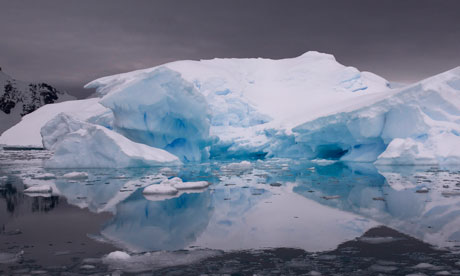
An ancient iceberg in Paradise Bay. Photograph: Bella Bathurst for the Observer
Back among the mapped territories, however, Shackleton lost his way. In photographs his face is young but his eyes are lightless. Five years later he contacted Wild – by then living and farming in South Africa – and asked if he'd like to act again as his second-in-command. The two balanced each other so well they almost became a single entity. "It is hardly necessary to write about him," Shackleton wrote of Wild in his book South. "He is my second self. I love him. He has been a tower of strength to me."
Methane discovery stokes new global warming fears Shock as retreat of Arctic releases greenhouse gas
Dramatic and unprecedented plumes of methane - a greenhouse gas 20 times more potent than carbon dioxide - have been seen bubbling to the surface of the Arctic Ocean by scientists undertaking an extensive survey of the region.
The scale and volume of the methane release has astonished the head of the Russian research team who has been surveying the seabed of the East Siberian Arctic Shelf off northern Russia for nearly 20 years. In an exclusive interview with The Independent, Igor Semiletov of the International Arctic Research Centre at the University of Alaska Fairbanks, who led the 8th joint US-Russia cruise of the East Siberian Arctic seas, said that he has never before witnessed the scale and force of the methane being released from beneath the Arctic seabed.
"Earlier we found torch-like structures like this but they were only tens of metres in diameter. This is the first time that we've found continuous, powerful and impressive seeping structures more than 1,000 metres in diameter. It's amazing," Dr Semiletov said. "I was most impressed by the shear scale and the high density of the plumes. Over a relatively small area we found more than 100, but over a wider area there should be thousands of them," he said.
Scientists estimate that there are hundreds of millions of tons of methane gas locked away beneath the Arctic permafrost, which extends from the mainland into the seabed of the relatively shallow sea of the East Siberian Arctic Shelf. One of the greatest fears is that with the disappearance of the Arctic sea ice in summer, and rapidly rising temperatures across the entire Arctic region, which are already melting the Siberian permafrost, the trapped methane could be suddenly released into the atmosphere leading to rapid and severe climate change..
Monday, 5 December 2011
Protecting the Himalaya: Centre for Integrated Mountain Development
The International Centre for Integrated Mountain Development, ICIMOD, is a regional knowledge development and learning centre serving the eight regional member countries of the Hindu Kush-Himalayas - Afghanistan, Bangladesh, Bhutan, China, India, Myanmar, Nepal, and Pakistan. Visit this site for data and comment ranging from the impact of climate change on the Himalaya to livelihoods, bio-diversity, river waters, flora and fauna, etc etc.

http://www.icimod.org/
http://www.icimod.org/
Sunday, 4 December 2011
India emerges as chief opponent of a new global-warming treaty
India is now the leading opponent of a new comprehensive global-warming treaty, it became clear at the weekend after the first week of negotiations at the UN Climate Conference in Durban, South Africa. The world's second most populous country has resolutely set its face against a fresh climate deal that at some stage would involve every country in the world cutting its carbon emissions in an effort to bring climate change under control.
The Indians are refusing to approve anything that might put a brake on their economy, now expanding with growth in 2010 estimated at 10.4 per cent. Its carbon emissions are growing at more than 9 per cent a year, the fastest of any major nation, and the country has shot up to become the world's third biggest carbon emitter, after China and the US.
But the Indians are relying on this growth to take hundreds of millions of their nearly 1.2 billion people out of poverty and they want nothing to do with curbing these emissions.
Instead, along with some other emerging economies, India is seeking a renewal of the Kyoto Protocol, the 1997 climate agreement due to run out next year under which Western industrialised countries agreed to make reductions in their emissions of greenhouse gases, while developing countries such as China and India had no obligations to make cuts at all.
The conference and the whole 20-year UN climate negotiating process are threatened with stalemate over the Kyoto issue, as three nations – Japan, Russia and Canada – have stated that they will not renew the protocol under any circumstances, considering it wholly unfair. Britain and the EU are trying to break the deadlock, offering to renew the protocol as long as agreement can also be reached on a way forward, a "road map", towards a new all-embracing climate treaty, to be signed by 2015 – a legally binding framework by which each country would be committed to take action over its CO2 emissions, although not necessarily to the same degree or at the same time.
Without such a treaty, there is no chance of the world halting the rising temperature of the atmosphere.
Without such a treaty, there is no chance of the world halting the rising temperature of the atmosphere.
Saturday, 3 December 2011
Durban Conference: The forgotten planet
The world's ministers and their mandarins gather in their thousands this weekend to hammer out a plan for the small matter of saving the planet. Yet few of us appear to have noticed. Despite apocalyptic warnings about temperatures reaching record levels and carbon emissions rising faster than ever, the delegates at the vast UN climate conference in South Africa this weekend could not be further from reaching a deal – or further from the thoughts of a global population gripped by economic fears.
More than 10,000 ministers, officials, campaigners and scientists from 194 countries are meeting in Durban in an attempt to counter the devastating effects of global warming. With little hope of a major agreement, many are happy to be out of the spotlight.
Not long ago, politicians were proclaiming that climate change was the greatest threat facing the world. David Cameron drove a pack of huskies across a glacier, proclaiming that the Conservatives had to lead a "new green revolution and recapture climate change from the pessimists". Today, amid the preoccupations of a global recession, the future of the world itself seems a secondary concern for the political classes.
The key villain remains the United States, which a year before presidential elections will not sign up to a new green target. China will not play ball either. Japan, Russia and Canada have pulled out of the current negotiations.
Thursday, 1 December 2011
Protests in Peru halt Newmont gold mine project
US company Newmont which is planning a huge open-cast gold mine in northern Peru says it is halting construction after days of protests. At least 10 people were injured on Tuesday at the site in the high Andes. Critics say the $4.8bn (£3.1bn) mining project will cause pollution and destroy water supplies. The Denver-based mining giant has promised to resume dialogue with local residents and the government in an effort to reach a compromise.
Newmont, based in Denver, Colorado, is the majority owner of the Conga project, which was to begin production in 2015 and is an extension of Yanacocha, Latin America's biggest gold mine. "For the sake of re-establishing tranquillity and social peace in Cajamarca (region), it has been decided to suspend the project's activities," said a statement from the Yanacocha mine, operated by Newmont and its local partner Buenaventura.
The Conga project, located some 3,700 m (12,140 feet) above sea level, involves moving the water from four lakes high in the mountains into reservoirs the company would build.http://www.bbc.co.uk/news/world-latin-america-15956429
Subscribe to:
Posts (Atom)