Showing posts with label Poetry. Show all posts
Showing posts with label Poetry. Show all posts
Saturday, 9 November 2013

Anshu Malviya's Poem: कौसर बनो की अजन्मी बिटिया की ओर से [From Kauser Bano’s Unborn Daughter]
An English version of this poem by Anshu Malviya appeared in Communalism Combat of February-March 2012. It was Translated from the Hindi by Javed Anand
http://www.sabrang.com/cc/archive/2012/feb-march12/voices.pdf
Thursday, 26 April 2012
The best children’s poem of 2005
When I born, I Black,
When I grow up, I Black,
When I go in Sun, I Black,
When I scared, I Black,
When I sick, I Black,
And when I die, I still black…
And
you White fellow,
When you born, you pink,
When you grow up, you White,
When you go in Sun, you Red,
When you cold, you blue,
When you scared, you yellow,
When you sick, you Green,
And when you die, you Gray…
And you call me colored???……… “
“This poem was voted the best children’s poem of 2005. It was written by an African kid.
http://vosje.wordpress.com/2006/09/26/the-best-childrens-poem-of-2005/
Tuesday, 14 February 2012
'Anticipation of Love' and other poems by Jorge Luis Borges
"In the dream of the man who was dreaming, the dreamt man awoke" The Circular Ruins
Anticipation of Love
Neither the intimacy of your look, your brow fair as a feast day,
nor the favor of your body, still mysterious, reserved, and childlike,
nor what comes to me of your life, settling in words or silence, will be so mysterious a gift
as the sight of your sleep, enfolded
in the vigil of my arms.
Virgin again, miraculously, by the absolving power of sleep,
quiet and luminous like some happy thing recovered by memory,
you will give me that shore of your life that you yourself do not own.
Cast up into silence
I shall discern that ultimate beach of your being
and see you for the first time, perhaps,
as God must see you --
the fiction of Time destroyed,
free from love, from me.
(translated by Alastair Read)
The Just
A man who cultivates his garden, as Voltaire wished.
He who is grateful for the existence of music.He who takes pleasure in tracing an etymology.
Two workmen playing, in a café in the South, a silent game of chess.
The potter, contemplating a color and a form.
The typographer who sets this page well, though it may not please him.
A woman and a man, who read the last tercets of a certain canto.
He who strokes a sleeping animal.
He who justifies, or wishes to, a wrong done him.
He who is grateful for the existence of a Stevenson.
He who prefers others to be right.
These people, unaware, are saving the world.
'Borges seems to be saying that more mysterious and magical than dreams or other worlds are the voices and words of our loved ones; beauty is a daily revelation, and happiness, the intelligence of understanding and recognition. Borges has become our classic voice of wonder' - Julio Ortega
The Moon
There is such loneliness in that gold
The moon of the nights is not the moon
Whom the first Adam saw. The long centuries
Of human vigil have filled her
With ancient lament. Look at her. She is your mirror.
(for Maria Kodama)
The Maker
We are the river you spoke of, Heraclitus
We are time. Its tangible course
Carries lions and mountains alongThe tears of love, the ashes of pleasure
Insidious interminable hope,
Immense names of empires turned to dust
Hexameters of the Greeks and Romans,
A gloomy ocean under the power of dawn
Sleep, that foretaste of death
Weapons and the warrior, monuments,
The two faces of Janus ignorant of each other,
The ivory labryinths woven
By chess pieces moving over the board,
The red hand of Macbeth which has the power,
To turn the seas to blood, the secret
Working of clocks in the shadows,
A boundless mirror which regards itself
In another mirror and no one there to see them,
Steel engravings, Gothic lettering,
A bar of sulfur left in a cabinet,
The heavy tollings of insomnia,
Sunrises and sunsets and twilights,
Echoes, undertows, sand, lichen, dreams,
I am nothing but those images
Shuffled by chance and named by tedium,
From them, even though I am blind and broken,
I must craft the incorruptible lines
And (this is my duty) save myself.
Friday, 10 February 2012
The Bell Jar Shatters: The Political Poetry of Dahlia Ravikovitch
At the end of August 2005, Dahlia Ravikovitch, one of the great Hebrew poets of our time, was found dead in her apartment in Tel Aviv. The outpouring of grief in the Israeli media testifies to the the major role that Ravikovitch played in the world of Hebrew letters. Ravikovitch was well-known for the fearless clarity with which she took on political issues, not only in her poetry but also in the public arena. She frequently participated in protests against the Occupation and the oppression of the Palestinians. Nor did Ravikovitch hesitate to speak out about Israeli society; as Lawrence Joffe noted in an obituary in the Guardian, "She campaigned for Palestinian rights, and against messianic settler nationalists, yet she also criticized her fellow Israeli secularists' 'culture of nothingness.'" Whenever Ravikovitch appeared on TV, speaking truth to power in her precise, unadorned language, undeterred and undeflected by the scripted pronouncements of politicians and generals, there would be a morning-after tempest in all the newspapers. Poets still have a vital presence in Israel, it appears—especially considering their marginality in our own society, where such a response would be unimaginable.
At a writers' conference in Berkeley in the late 1980s, we asked Dahlia Ravikovitch what made her turn so forcefully to the political in her poetry after years of writing primarily personal lyrics. Her answer came quickly: "Till the invasion of Lebanon [in 1982], I managed somehow to go on living inside a bell jar. But then suddenly, all at once, when the invasion started, the bell jar shattered. Now there's no wall between the political and the personal. It all comes rushing in."
At the time of her death, Dahlia Ravikovitch was considered Israel's greatest living poet. She produced a powerful body of work—ten volumes of poetry, three collections of short stories, and several books of childrens' verse—and translated Poe, Yeats, and Eliot, as well as children's classics, into Hebrew. A much-beloved poet, widely honored for her artistry and her courage, Ravikovitch enjoyed canonical stature from the beginning of her career, and was considered a cultural icon in Israel..
http://www.tikkun.org/article.php/Chana-TheBellJarShatters‘If I didn’t know despair myself, I would not be able to feel the anguish of the oppressed’, she told one interviewer. Here’s the title poem of her collected works, ‘Hovering at a Low Altitude’, where ‘gradually it becomes apparent we are witnessing the rape and murder of a young Arab girl through the eyes of the perpetrator’.
http://elegantthorn.blogspot.in/2009/04/poetry-month-dahlia-ravikovitch.htmlWednesday, 11 January 2012
I Am Nobody's Nigger by Dean Atta
Rappers when you use the word "nigger" remember that's one of the last words Stephen Lawrence heard, so don't tell me it's a reclaimed word.
I am nobody's nigger
So please, let my ancestors rest in peace
Not turn in their graves in Jamaica plantations
Or the watery graves of the slave trade
Thrown overboard into middle passage
Just for insurance claims
They were chained up on a boat
As many as they could manage and stay afloat
Stripped of dignity and all hope
Awaiting their masters and European names
But the sick and the injured were dead weight to toss
And Lloyds of London would cover that cost.
I am nobody's nigger
So you can tell Weezy and Drake
That they made a mistake
I am nobody's nigger now
So you can tell Kanye and Jigga
I am not a nigger... in Paris
I'm not a nigger in London
I'm not a nigger in New York
I'm not a nigger in Kingston
I'm not a nigger in Accra
Or a nigger with attitude in Compton
Cos "I don't wanna be called yo nigga"
How were you raised on Public Enemy
And still became your own worst enemy?
You killed Hip Hop and resurrected headless zombies
That can't think for themselves or see where they're going
Or quench the blood lust because there's no blood flowing
In their hearts, just in the streets
They don't give a damn as long as they eating
Their hearts ain't beating, they're cold as ice (bling)
Because they would put money over everything
Money over self respect or self esteem
Or empowering the youth to follow their dreams
Stacking paper cos it's greater than love it seems
Call me "nigger" cos you're scared of what "brother" means
To know that we share something unspeakable
To know that as high as we rise we are not seen as equal
To know that racism is institutional thinking
And that "nigger" is the last word you heard before a lynching.
To know that as high as we rise we are not seen as equal
To know that racism is institutional thinking
And that "nigger" is the last word you heard before a lynching.
Also see:
Dean Atta's angry, rapidly written poem about Stephen Lawrence went viral last week.
Until last week, Dean Atta was relatively unknown; unless you were deeply immersed in the world of spoken word you probably wouldn't have heard of him. Then, in the wake of the conviction of Gary Dobson and David Norris for the murder of Stephen Lawrence, he wrote his poem I Am Nobody's Nigger, and took the internet by storm. In five days, his poem had received in excess of 15,000 hits and gained him an extra 1,000 followers on Twitter. The poem was, he says, a reaction to "the injustice of the death of Stephen Lawrence", and to the loose usage of the N-word. "Watching Panorama, where they reconstructed his murder, and hearing that the N-word was the last thing they said when they stabbed him really struck a chord with me."
The poem began as an update on Facebook and post on Twitter, saying: "Rappers, when you use the word 'nigger' remember that's one of the last words Stephen Lawrence heard, so don't tell me it's a reclaimed word." It received 80 likes and 50 retweets, and became the first line of a poem he wrote in 30 minutes. We meet at a poetry event on Brick Lane in east London. The evening is the brainchild of Clarissa Pabi, a former president of the Oxford University Poetry Society, and features poetry, music, film installation and open mics – a chance for aspiring poets and musicians to perform. Atta arrives, smiling in a grey hat and pink jumper, and is recognised by many guests.
The 27-year-old Londoner has been writing and performing for more than 10 years. ..
Monday, 9 January 2012
MOONLIGHT SONATA - Yiannis Ritsos
A spring evening. A large room in an old house. A woman of a certain age, dressed in
black, is speaking to a young man. They have not turned on the lights. Through both
windows the moonlight shines relentlessly. I forgot to mention that the Woman in
Black has published two or three interesting volume of poetry with a religious flavor.
So, the Woman in Black is speaking to the Young Man:
I know that each one of us travels to love alone,
alone to faith and to death.
I know it. I’ve tried it. It doesn’t help.
Let me come with you.
Let me come with you. What a moon there is tonight!
The moon is kind – it won’t show
that my hair turned white. The moon
will turn my hair to gold again. You wouldn’t understand.
Let me come with you. ..
When there’s a moon the shadows in the house grow larger,
invisible hands draw the curtains,
a ghostly finger writes forgotten words in the dust
on the piano – I don’t want to hear them. Hush.
Let me come with you
a little farther down, as far as the brickyard wall,
to the point where the road turns and the city appears
concrete and airy, whitewashed with moonlight,
so indifferent and insubstantial
so positive, like metaphysics,
that finally you can believe you exist and do not exist,
that you never existed, that time with its destruction never existed.
Let me come with you.
Read the full poem: http://greece.poetryinternationalweb.org/piw_cms/cms/cms_module/index.php?obj_id=2678
You Playmates of Mine: Rilke
Be patient toward all that is unsolved in your heart and try to love the questions themselves like locked rooms and like books that are written in a very foreign tongue. Do not now seek the answers, which cannot be given you because you would not be able to live them. And the point is, to live everything. Live the questions now. Perhaps you will find them gradually, without noticing it, and live along some distant day into the answer. Rainer Maria Rilke, Letters to a Young Poet
You Playmates of Mine
You playmates of mine in the scattered parks of the city,
small friends from childhood of long ago:
how we found and liked one another, hesitantly,
and, like the lamb with the talking scroll,
spoke with our silence. When we were filled with joy
it belonged to no one: it was simply there.
And how it dissolved among all the adults who passed by
and in the fears of the endless year.
Wheels rolled past us, we stood and stared at the carriages;
horses surrounded us, solid but untrue--and none
of them ever knew us. What in the world was real?
Nothing. Only the balls. Their magnificent arches.
Not even the children . . . But sometimes one,
oh a vanishing one, stepped under the plummeting ball.
Rainer Maria Rilke (In memoriam Egon von Rilke)
Saturday, 17 December 2011
'I'm suffering from a headache and the universe' - Fernando Pessoa's multiple voices
The Book of Disquiet
Fernando Pessoa, trans. Richard Zenith
Fernando Pessoa, trans. Richard Zenith
Was 18 March 1914 the most extraordinary date in modern literature? On that day, Fernando Antonio Nogueira Pessoa (1888-1935) took a sheet of paper, went to a tall chest of drawers in his room and began to write standing up, as he customarily did. 'I wrote 30-odd poems in a kind of trance whose nature I cannot define. It was the triumphant day of my life, and it would be impossible to experience such a one again.'
Other poets, notably Rilke, have experienced such hours of explosive prodigality. But Pessoa's case is different and, probably, unique. The first set of poems was by one 'Alberto Caeiro' - 'my Master had appeared inside me.' The next six were composed by Pessoa struggling against the 'inexistence' of Caeiro. But Caeiro had disciples, one of whom, 'Ricardo Reis', contributed further poems. A fourth individual 'burst impetuously on the scene. In one fell swoop, at the typewriter, without hesitation or correction, there appeared the "Ode Triumphal" by "Alvaro de Campos" - the Ode of that name and the man with the name he now has.'
Pseudonymous writing is not rare in literature or philosophy (Kierkegaard provides a celebrated instance). 'Heteronyms', as Pessoa called and defined them, are something different and exceedingly strange. For each of his 'voices', Pessoa conceived a highly distinctive poetic idiom and technique, a complex biography, a context of literary influence and polemics and, most arrestingly of all, subtle interrelations and reciprocities of awareness. Octavio Paz defines Caeiro as 'everything that Pessoa is not and more'.
He is a man magnificently at home in nature, a virtuoso of pre-Christian innocence, almost a Portuguese teacher of Zen. Reis is a stoic Horatian, a pagan believer in fate, a player with classical myths less original than Caeiro, but more representative of modern symbolism. De Campos emerges as a Whitmanesque futurist, a dreamer in drunkenness, the Dionysian singer of what is oceanic and windswept in Lisbon. None of this triad resembles the metaphysical solitude, the sense of being an occultist medium which characterise Pessoa's 'own' intimate verse.
Other masks followed, notably one 'Bernardo Soares'. At some complex generative level, Pessoa's genius as a polyglot underlies, is mirrored by, his self-dispersal into diverse and contrasting personae. He spent nine of his childhood years in Durban. His first writings were in English with a South African tincture. He turned to Portuguese only in 1910 (there are significant analogies with Borges).
Pessoa earned his living as a translator. His legacy, enormous and in large part unpublished, comports philosophy, literary criticism, linguistic theory, writings on politics in Portuguese, English and French. Like Borges, Beckett or Nabokov, Pessoa shows up the naive, malignant falsehood still current in certain Fenland English faculties whereby only the monoglot and native speaker is inward with style and literary insight.
The fragmentary, the incomplete is of the essence of Pessoa's spirit...
http://www.guardian.co.uk/books/2001/jun/03/poetry.features1
Monday, 12 December 2011
The pump you pump the water from: Sven Birkerts on writer’s block.
Writing can’t be planned for or predicted, and when it happens, when the surge begins, it brings a satisfaction like nothing else. There are finer sensualities, sure, and basic emotions that give joy or connection when released, but as far as giving me a sustained sense that this is who I am, this is what I do, a full-fathom immersion in writing is the ultimate verification. Alone at my attic desk, catching the flow of words, when the flow is there to be caught — or generating it when it is there to be generated — I break with my more tentative self, claim some more necessary seeming “I.” The change has everything to do with finding words and their sequence. The joy prolongs itself for a short time after I stop — a resonance, a psychic afterglow — then it tapers away, the other life resumes. But I am already thinking toward the next occasion.
The memory of the best of the best writing moments haunts, most grievously when the desire is there but the impulse is absent, or when the impulse flickers and sputters but doesn’t catch, when the words — which I believe are right there, as if on the other side of the sheerest membrane — will not come. The good runs are not a fortifying memory but a reproach. My younger self — it is always, necessarily, the younger self — mocks me. It’s not just writing at stake, but everything. The worth I felt when I worked, when I was young — even if that was only yesterday — is gone. This is now and henceforth the way of things; this is the new reality..
..Coleridge, we know, wrote not only the early poetry for which he is remembered, but later prose of different descriptions, including the Biographia Literaria, one of the founding documents of literary criticism. In Coleridge’s case ‘blockage’ was a relative diagnosis. Though he wrote his superlative prose for decades after the poetry stopped, that production was no recompense. For him there was no comparing the “rightness” that he had experienced in the seizure of poetic composition to what he achieved in the other medium — neither in terms of personal gratification, or ultimate value. Coleridge lived under the banner of Romanticism, upon which was inscribed Shelley’s rallying assertion that “The poet is the unacknowledged legislator of the world.” Through the language of poetry — language in its highest incarnation — are the ultimate truths made manifest. It is not given to the essayist or critic to draw that deeply from the wells of inspiration...
Where did it start, this bizarrely complex meshing of my sense of self-worth with my ability to express myself in writing?
http://lareviewofbooks.org/post/13778802292/the-pump-you-pump-the-water-from
Tuesday, 6 December 2011
Thirteen Ways of Looking at a Blackbird : Wallace Stevens
I
Among twenty snowy mountains,
The only moving thing
Was the eye of the blackbird.
II
I was of three minds,
Like a tree
In which there are three blackbirds.
III
The blackbird whirled in the autumn winds.
It was a small part of the pantomime.
IV
A man and a woman
Are one.
A man and a woman and a blackbird
Are one.
V
I do not know which to prefer,
The beauty of inflections
Or the beauty of innuendoes,
The blackbird whistling
Or just after.
Read the whole poem: http://writing.upenn.edu/~afilreis/88/stevens-13ways.html
Monday, 5 December 2011
Selected poems by Wang Wei (699-759 AD)
Peach Blossom Spring
A fisherman floated on, enjoying Spring.
The shores, he found, were covered in Peach Blossom.
Watched reddening trees, uncertain where he was.
Seeing no one reached green water springs.
There a way led through the hill.
Twisting, turning to a vast plain.
Distant trees rose to the clouds.
Houses stretched among bamboo and flowers.
Woodmen had names from times of Chou,
Clothes they wore were those of Ch’in,
Once had lived near Wu-ling River,
Now they lived outside the world.
Bright moon in pines. By their doors peace.
Sunrise. From clouds the wild birds call.
Amazed, they want to see this stranger,
Invite him; ask questions of his country.
At first light they sweep flowers from the gate.
At dusk fishermen, woodmen ride the stream.
They had sought refuge there from the world,
Became Immortals, never returned.
Who in those hills can know the world of men,
Who, gazing out, sees only clouds and hills?
He forgot Paradise is hard to find.
His spirit turned again to his own home.
Leaving those hidden streams and mountains,
Thought he could return when he wished,
Knew the way. How could he go wrong?
Who can know how hills and valleys alter?
He only knew the deep ways he wandered.
How many green streams in those cloudy woods?
When Spring comes a myriad Peach-filled rivers,
Who knows which one might lead to Paradise?
Sunday, 4 December 2011
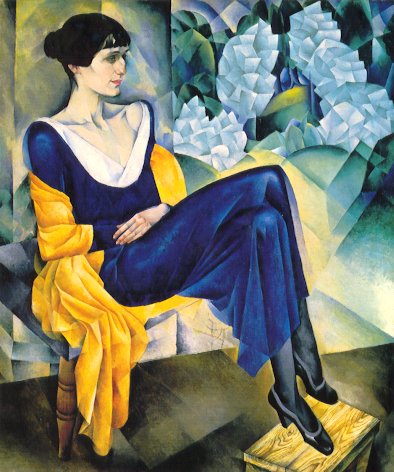
Anna Akhmatova: Forty-Five Poems Including ‘Requiem’
Reading Hamlet
To the right, wasteland by the cemetery
beyond it the river’s dull blue.
beyond it the river’s dull blue.
You said: ‘Go, get thee, to a nunnery
or get a fool to marry you…’
Though that’s always how Princes speak,
still, I’ve remembered the words.
As an ermine mantle let them stream,
behind him, through endless years.
‘Hands clasped under the dark veil.’
Hands clasped, under the dark veil.
‘Today, why are you so pale?’
– Because I’ve made him drink his fill
of sorrow’s bitter tale.
How could I forget? He staggered,
his mouth twisted with pain…
I ran down not touching the rail,
I ran all the way to the gate.
‘I was joking,’ I cried, breathlessly.
‘If you go away, I am dead.’
Smiling strangely, calmly,
‘Don’t stand in the wind,’ he said.
‘There’s a secret border in human closeness’
There’s a secret border in human closeness,
that love’s being, love’s passion, cannot pass –
though lips are sealed together in sacred silence,
though hearts break in two with love’s distress.
And friendship too is powerless, and years
of sublime flame-filled ecstasy
when the soul itself is free, fights clear,
of the slow languor of sensuality.
Those who try to reach that boundary are mad,
and those who have – are filled with anguish.
Now you know, now you understand,
why my heart won’t beat at your caress.

Lot’s Wife
The just man followed God’s messenger,
vast and bright against the black hill,
but care spoke in the woman’s ear:
‘There’s time, you can look back still,
at Sodom
you were born,
the square where you sang, where you’d spin,
the high windows of your dark home,
where your children’s life entered in.
She looked, and was transfixed by pain,
uncertain whether she could still see,
her body had turned to translucent salt,
her quick feet rooted there, like a tree.
A loss, but who still mourns the breath
of one woman, or laments one wife?
Though my heart never can forget,
how, for one look, she gave up her life.
Note: The reference is to Lot
Epilogue (from Requiem 1940-1943)
I learned to know how faces fall apart,
how fear, beneath the eye-lids, seeks,
how strict the cutting blade, the art
that suffering etches in the cheeks.
How the black, the ash-blond hair,
in an instant turned to silver,
learned how submissive lips fared,
learned terror’s dry racking laughter.
Not only for myself I pray,
but for all who stood there, all,
in bitter cold, or burning July day,
beneath that red, blind prison wall.
The poem “Rekviem” (“Requiem”) is Anna Akhmatova’s best known work. It is a composition that is made up of several shorter poems, all reflecting the anguish of the Russian people during the years of persecution under Joseph Stalin. Akhmatova was hesitant to trust the poem to paper, so consequently, it was memorized by the poet and a few of her trusted friends. It was published in the 1960s, after Stalin’s death. While the poem refers to Stalin’s oppressive rule, it is important to remember that the poem was also written during a time of war. The other poems in this section were written at the bequest of the Soviet government to admonish the German’s siege of Leningrad and their invasion of the Soviet Union. Stalin asked for Akhmatova to write poems about the “Siege” in order for them to be shared with the nation via radio broadcast. Akhmatova was evacuated from the city in 1943, by the Soviet army, for her safety.
and about her: http://www.uvm.edu/~sgutman/Akhmatova.htm
Subscribe to:
Posts (Atom)